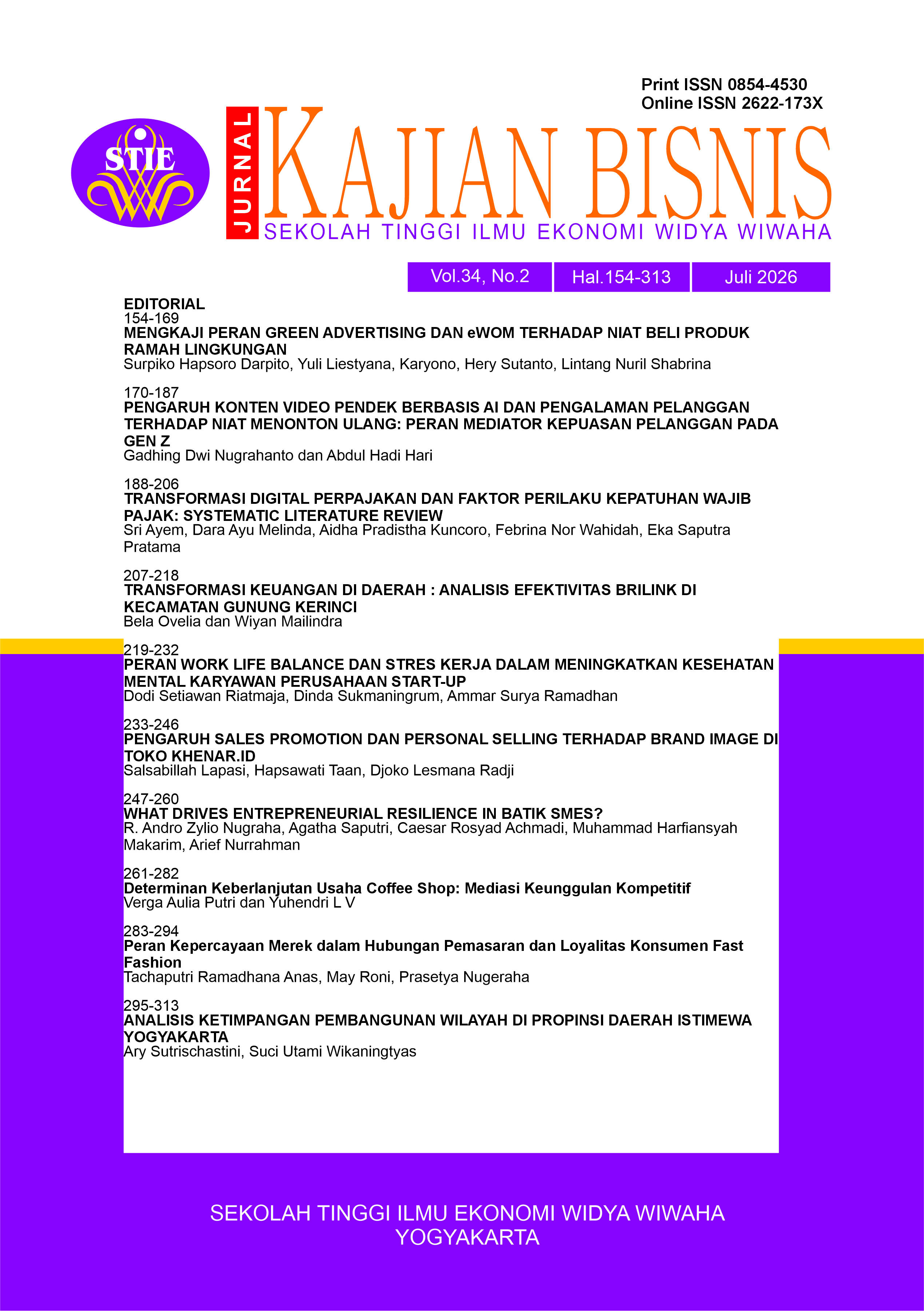
Peran Kepercayaan Merek dalam Hubungan Pemasaran dan Loyalitas Konsumen Fast Fashion
DOI:
https://doi.org/10.32477/m116ps05Keywords:
Community Relationship Marketing, Brand Trust, Brand Loyalty, Uniqlo, Customer Relationship MarketingAbstract
This study examines the mediating role of brand trust in the relationship between Community Relationship Marketing (CoRM), Customer Relationship Marketing (CRM), and Brand Loyalty among Uniqlo consumers in Indonesia, a fast-growing fashion market driven by consumers who value personalized experience, strong community, and long-term brand engagement. Using quantitative approach, primary data were collected from a sample of 97 Uniqlo consumers through a structured questionnaire and analyzed with Partial Least Square Structural Equation Modeling (PLS-SEM) in SmartPls. Both CoRM and CRM have a significant positive effect on brand trust and brand loyalty, brand trust significantly and positively affects brand loyalty, and brand trust partially mediates the effect of both relational marketing strategies on brand loyalty. The strongest structural effect is the CRM - Brand Trust path (β = 0.546), indicating that direct customer engagement is the most powerful mechanism for building consumer trust. To sustain customer trust and loyalty in Indonesia's highly competitive fashion market, Uniqlo should strengthen customer-centric and community-based relationship marketing strategies.
Downloads
References
Aaker, D.A. 1996. Building Strong Brands. New York: The Free Press.
Chaudhuri, A. & Holbrook, M.B. 2001. The chain of effects from brand trust and brand affect to brand performance: The role of brand loyalty. Journal of Marketing, 65(2), pp.81–93.
Delgado-Ballester, E. & Munuera-Alemán, J.L. 2001. Brand trust in the context of consumer loyalty. European Journal of Marketing, 35(11/12), pp.1238–1258.
Ghozali, I. 2021. Partial Least Squares: Konsep, Teknik dan Aplikasi menggunakan Program SmartPLS. Semarang: Badan Penerbit Universitas Diponegoro.
Griffin, J. 2005. Customer Loyalty: Menumbuhkan dan Mempertahankan Kesetiaan Pelanggan. Jakarta: Erlangga.
Grönroos, C. 1994. From marketing mix to relationship marketing: Towards a paradigm shift in marketing. Management Decision, 32(2), pp.4–20.
Hair, J.F., Hult, G.T.M., Ringle, C.M. & Sarstedt, M. 2021. A Primer on Partial Least Squares Structural Equation Modeling (PLS-SEM). 3rd edn. Thousand Oaks: Sage.
Huang, L. 2021. Brand community engagement and its effect on brand loyalty: Evidence from social media platforms. Journal of Brand Management, 28(3), pp.210–225.
Kotler, P. & Keller, K.L. 2016. Marketing Management. 15th edn. New Jersey: Pearson Education.
Lau, G.T. & Lee, S.H. 1999. Consumers' trust in a brand and the link to brand loyalty. Journal of Market-Focused Management, 4(4), pp.341–370.
Liu, Y. 2023. The role of online brand communities in shaping consumer loyalty in the fashion retail sector. Journal of Retailing and Consumer Services, 71, 103–115.
Mills, A.J. et al. 2022. Brand community and consumer loyalty in digital marketing. Journal of Marketing Research, 14(2), pp.45–63.
Morgan, R.M. & Hunt, S.D. 1994. The commitment-trust theory of relationship marketing. Journal of Marketing, 58(3), pp.20–38.
Muniz, A.M. & O'Guinn, T.C. 2001. Brand community. Journal of Consumer Research, 27(4), pp.412–432.
Santoso, A., Wijaya, R. & Putri, N. 2024. The influence of community relationship marketing on customer loyalty in the fashion industry. Journal of Marketing Management, 12(1), pp.45–56.
Schiffman, L.G. & Kanuk, L.L. 2010. Consumer Behavior. 10th edn. New Jersey: Pearson Education.
Sugiyono. 2022. Metode Penelitian Kuantitatif. Bandung: Alfabeta.
Yuan, X., Chen, H. & Park, S. 2024. Fashion consumption as identity and social expression in the digital era. Fashion Theory: The Journal of Dress, Body & Culture, 28(1), pp.55–74.
Downloads
Published
Issue
Section
License
Copyright (c) 2026 Tachaputri Ramadhana Anas, May Roni, Prasetya Nugeraha

This work is licensed under a Creative Commons Attribution 4.0 International License.